



Ground systems explained | Updated July 2026
A permeable surface does not make rain disappear. It changes the route: water passes through the finish, enters the base, and must then infiltrate, be stored, be conveyed-or follow a designed combination of all three.
Good permeable surface drainage follows water beyond the visible finish. Grass grids, gravel stabilisation grids, permeable block paving, porous asphalt and pervious concrete solve different surface needs, yet they share a basic principle: rainfall can move downward instead of becoming immediate surface runoff. The U.S. EPA's permeable pavement guidance explains that these surfaces allow rain and snowmelt to pass into underlying soil and gravel, helping reduce runoff and filter pollutants.
That benefit is real, but it should not be oversimplified. Permeability at the top does not guarantee adequate capacity below. A compacted or low-permeability subgrade, a high water table, fine sediment, an intense storm or a restricted outlet can all cause water to build up. Good design follows the water all the way from the surface to its final destination.
The five layers in a typical water path
Three possible destinations for the water
Infiltrate into the subgrade
This is often the simplest hydraulic route, but it is only appropriate after site investigation. Infiltration rate, seasonal groundwater, adjacent foundations, slopes and contamination risk all matter. A geotechnical or drainage engineer should set the design rate and separation requirements.
Enter an underdrain and controlled outlet
Where infiltration is limited, perforated drainage can collect water from the base and convey it to a permitted connection. An orifice or other flow control may slow discharge. The base then works as a distributed temporary reservoir, provided its effective void volume and drawdown time are included in the calculations.
Move into additional modular storage
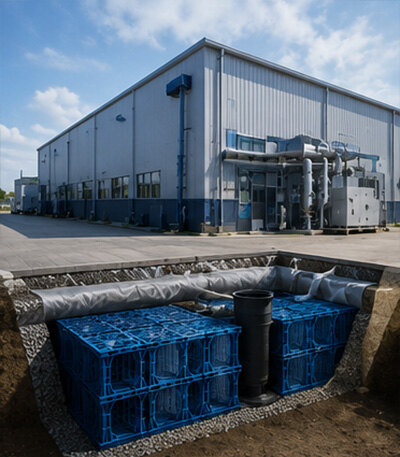
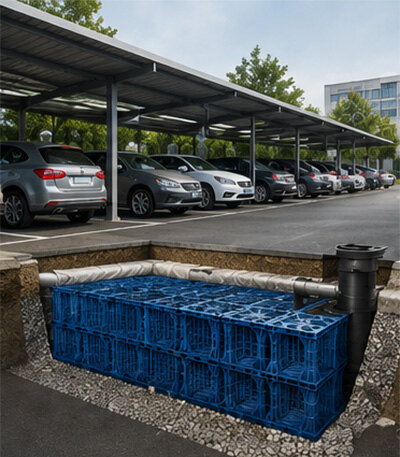
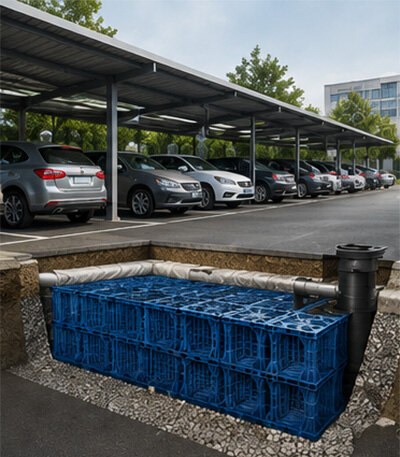
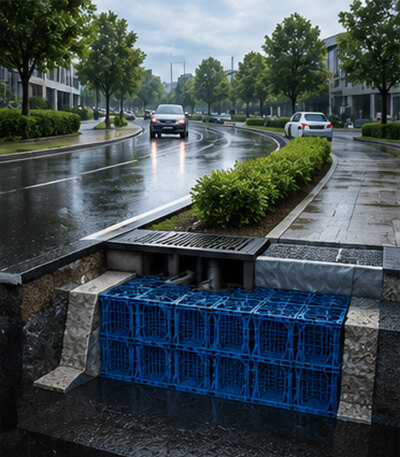
A geocellular tank can add substantial volume where the open-graded base alone cannot meet the required event. It may sit below or beside the permeable area, depending on loading, levels, access and available excavation. This option is especially relevant on dense sites where a surface pond or large open basin would displace parking, access or recreation.
Parking, roads and sports areas behave differently
| Application | Hydraulic concern | Structural or operational concern |
|---|---|---|
| Parking bays | Runoff from adjacent impermeable lanes may increase inflow. | Wheel loads, braking, sediment and possible hydrocarbons. |
| Roads and access lanes | Long flow paths and kerb inlets can concentrate water. | Repeated traffic, pavement design, utilities and maintenance access. |
| Sports fields | Rapid drainage is needed to preserve playability after rain. | Surface tolerance, rootzone stability and access for maintenance. |
| Grass overflow parking | Intermittent use may allow more infiltration time. | Cell fill, grass health, rut resistance and occasional peak loading. |
When an M2025 reservoir may be considered
M2025 modular geocellular crates can be assembled into an underground reservoir sized to the available footprint. Published data identifies a 1000 x 500 mm module plan, a 500 mm assembled height, approximately 0.23 m3 net water volume per crate and about 95% void ratio. ECO recycled-PP and higher-strength ULTRA virgin-PP versions are available.
The tank can be wrapped as an attenuation structure, an infiltration system or a watertight harvesting reservoir. That flexibility does not remove the need for design: traffic loading, cover, construction plant, soil, groundwater, long-term material behaviour, lining and inspection access must all be resolved for the actual site.
Maintenance begins at the surface
The most common performance threat is often not the crate but fine material entering from above. Landscape soil, unwashed joint aggregate, construction sediment and routine dirt can clog the surface or base. Protect permeable areas during construction, specify compatible aggregates and create a maintenance plan for vacuuming, sweeping, inlet cleaning and sediment removal. Inspection points at the tank do not compensate for a surface that has lost permeability.
- Keep sediment-generating work away from completed permeable areas.
- Use the specified clean, open-graded aggregates.
- Direct heavily polluted runoff through appropriate pretreatment.
- Record inspection locations before the surface is finished.
- Confirm a safe overflow route for events beyond the design capacity.
Frequently asked questions
Does permeable paving eliminate the need for drainage pipes?
Not always. Some sites can infiltrate water into suitable soil; others need an underdrain, controlled outlet or overflow. The drainage model and ground assessment determine the arrangement.
Can modular storage be installed under a car park?
It can be considered, but the responsible engineer must verify traffic loads, pavement build-up, cover, soil, groundwater, long-term performance and construction loading for the exact product version.
What is the difference between aggregate storage and geocellular storage?
Open-graded aggregate stores water in the spaces between stones while also supporting the surface. Geocellular modules create a much higher void space, so more water can be stored within a given excavation volume.
Can M2025 be used as a soakaway?
Yes, where infiltration testing and local requirements permit it, using a suitable permeable wrapping and a project-specific design.
Design the whole path, from surface to outlet
If the aggregate base cannot provide the required storage, compare the available footprint, net volume, cover and loading with the M2025 system data before developing a final engineered layout.
See M2025 Data and ApplicationsGeneral information only. Permeable pavement, infiltration and buried storage must follow the drainage, pavement and environmental requirements at the project location.